
Tangelic Talks – Season 04 | Episode 08
Beyond the Bucket List: Responsible Tourism, Community Investment & the Real Morocco w/ Azdean
15 minutes to read
What does it mean to be a “responsible” traveler? Lets journey to North Africa to explore how tourism can be a powerful tool for sustainability and local empowerment.
In this episode of Tangelic Talks, co-hosts Victoria Cornelio and Andres Tamez are joined by Azedan, a Morocco travel expert who is redefining the travel experience. We move past the typical tourist traps to discuss the “Riyadh” culture, the economic impact of local Argan co-ops, and the rigorous safety systems, like the dedicated tourism police, that make Morocco a top destination for solo travelers. Azedan shares why the future of travel isn’t just about seeing new places, but about an “exchange of people” that leaves a positive imprint on the communities we visit. Whether you’re a seasoned nomad or planning your first solo trip, this conversation offers a masterclass in traveling with purpose.
From Marrakech to a Movement: How Destination Morocco Was Born
Azdean’s journey into tourism didn’t start in a boardroom. It started with his son.
Born and raised in Marrakech, with family roots in a small village near Ouarzazate — home to a 400-year-old kasbah fortress — Azdean moved to the United States and built a life there. When his son was born, something shifted.
“He’s American. He’s born here. But he needs to know his roots. And one of the best ways to do that is to take him there.”
That son is now 10 years old, speaks Moroccan Arabic fluently, and pitches Morocco at travel shows better than his dad. That personal mission — keeping a family connected to its culture across continents — became the foundation for Destination Morocco.
But the seed had been planted much earlier. As a child in Marrakech, Azdean watched French and Spanish tour buses pass through his region toward Aït Benhaddou — the ancient ksar used as a filming location for Game of Thrones, Gladiator, and hundreds of other productions. He couldn’t understand what the tourists were looking at.
“To me, it was just mountains and rocks and dirt. But to them, they saw history. They saw incredible sights — so much more than I did as a kid.”
That gap between insider blindness and outsider wonder never left him. It became his life’s work to bridge it.
What Responsible Tourism Actually Means on the Ground
Azdean is quick to move past the abstract. For him, responsible tourism isn’t a philosophy — it’s a set of daily decisions about who gets paid, who gets seen, and who gets to tell their own story.
One of the most requested experiences his team now offers is direct community immersion — spending time with Amazigh (Berber) people in the Atlas Mountains, sharing meals with nomad families in the Sahara, participating in cooking classes sourced from local markets, and visiting women’s cooperatives where Argan oil, traditional carpets, and henna are made by hand.
Travelers aren’t passive observers here. At the women’s cooperatives in the Souss-Massa region, for example, visitors can watch the full Argan oil production process — the seed passing through five distinct stages — while engaging with the women who want to share their craft and knowledge. Those who prefer to work quietly, do. Those who want to connect, do. Nobody is put on display who hasn’t chosen to be.
“The women that want to be seen will be seen. The ones that want to stay behind the scenes still will.”
This distinction — between immersion and exploitation — is what Azdean calls the difference between authentic experience and what Victoria aptly named “the aquarium effect”: tourists pressing their faces against the glass at communities that had no say in being viewed.
Tourism That Trickles Down — All the Way Down
In 2024, Morocco ranked number one in Africa for tourist arrivals for the first time, surpassing Egypt with 17.4 million visitors. In 2025, driven by MICE events and the African Cup of Nations, that number climbed to 19.8 million. In a country where nearly every household has at least one person working directly or indirectly in tourism, the stakes of how that industry is managed are enormous.
Azdean is unambiguous about where Destination Morocco’s revenue goes: into the communities themselves.
He describes Khalil, a blind local guide in Casablanca who leads tours of the Hassan II Mosque, always accompanied by his son — two livelihoods supported by a single booking. He talks about the widows and single mothers who lead henna experiences in Marrakech. He describes paying above-market rates to local guides, drivers, and artisans — a deliberate practice that distinguishes Destination Morocco from multinational operators who may employ Moroccan staff at standard rates while profits leave the country entirely.
“The money really, really goes back deep into the community. It’s not going to a big corporation or a CEO.”
This isn’t altruism. It’s a business model built on the recognition that tourism powered by genuine community investment creates better experiences, stronger loyalty, and a more resilient local economy.
Breaking the Misconception: Morocco Is Not What the Media Told You
One of the most consistent themes in this episode is the gap between perception and reality for first-time visitors to Morocco.
Azdean shares the story of Max, a traveler who arrived terrified — convinced from media coverage that Morocco would be restrictive, unsafe, and unwelcoming. She was picked up at the airport by a young Moroccan woman in a skirt she described as shorter than anything she’d have let her own daughter wear.
“She was like, ‘I was so scared a week ago. And then I went to Morocco and everything was totally different. What a shock.'”
Morocco, Azdean explains, is a deeply diverse, cosmopolitan country. With over 200 international hotel brands, a vibrant nightlife in Marrakech and Casablanca, globally recognized cuisine, and a tradition of hospitality that visitors consistently rank as the country’s single greatest asset — Morocco is rarely what outsiders expect.
“People who have been to 30, 40, 50 countries always say there’s only one place they want to go back to: Morocco. And when I ask why — it’s always the people.”
He points to a structural reality: Morocco is roughly the driving distance of New York to Miami. Every major city — Fes, Marrakech, Chefchaouen, Tangier, Casablanca — has its own distinct culture, architecture, food traditions, and dialect. The scenery changes every 45 minutes on the road. There is no single Morocco to misunderstand.
Priming Travelers: How to Prepare People to Travel Responsibly
Azdean doesn’t leave cultural preparation to chance. Every traveler who books with Destination Morocco goes through a discovery call, followed by a pre-departure meeting to cover safety, cultural norms, dress codes, language basics, and practical logistics — including the reality that Moroccan roads don’t always match Google Maps’ estimated drive times.
Common questions he fields:
- What do I wear? Dress how you dress at home. Morocco is diverse and accustomed to tourists. The only specific guidance applies to mosque visits — covered shoulders, no hair covering required.
- Is it safe for solo women travelers? Yes — Moroccan cities have dense police presence, tourism police units specifically dedicated to protecting visitors, and extensive surveillance in major tourist areas like Marrakech’s Djemaa el-Fna.
- Will there be a language barrier? Morocco’s multilingual culture (Arabic, Amazigh, French, increasingly English) means most tourism interactions are manageable — and learning even a few words of Darija or French goes a long way.
His single most important piece of advice for any traveler?
“Learn about the destination before you get there. Lower your expectations a little — we’re very pampered in the US. And be nice. When you’re nice, even when things go wrong, you get so much more.”
The Immersive Difference: Riyadhs, Markets, and Living the Culture
One of the most distinctive elements of the Destination Morocco experience is accommodation. Rather than placing travelers in international hotel chains, Azdean books them into Riyadhs — traditional Moroccan family homes dating to the 19th century, each one architecturally unique, decorated differently, and embedded in the medina life of whichever city they’re in.
No two Riyadhs are alike. That is, by design, the point.
Add cooking classes that begin in the local souk — selecting vegetables, negotiating prices, learning the kitchen — and continue at a family home or farm where everything is organic and seasonal. Add a day in the Sahara that doesn’t end after a camel ride at sunset, but continues into Gnawa music at a Khamlia village, fossil discoveries in the desert rock, and an overnight with a nomad family. The result is travel that doesn’t just visit a place — it inhabits it.
Key Takeaways from This Episode
🌍 Responsible tourism starts with people, not policies. Community immersion, fair pay, and local ownership are what separate genuine sustainable tourism from greenwashed marketing.
🧭 Morocco is vastly underestimated. At 17–20 million visitors annually, it’s Africa’s top destination — but still misrepresented in global media. The reality is diverse, safe, warm, and extraordinary.
💰 Money should stay in the community. Destination Morocco prioritizes local guides, women’s cooperatives, family-owned Riyadhs, and above-market wages — ensuring tourism revenue circulates locally rather than flowing to distant shareholders.
🤝 Connection is the product. The most consistent feedback Azdean receives from travelers across 50+ countries isn’t about landscapes or food. It’s about the people they met.
📚 Prepare before you arrive. Learn a few words. Research the history. Lower the expectations shaped by media portrayals. The gap between perception and reality in Morocco is wide — and crossing it is the experience.
Final Thoughts
Azdean’s story is, at its core, about belonging — and the way travel can restore it. He built Destination Morocco so his son would know his roots. He stayed in it because he discovered that thousands of travelers were searching for exactly the same thing: not a checklist of sights, but a genuine sense of having been somewhere real, among real people, in a place that welcomed them.
His model proves what the best episodes of Tangelic Talks keep returning to: that sustainability, justice, and quality of life are not competing values. In tourism, as in energy and agriculture, the most community-centered approach is also the most commercially compelling one. When travelers feel connected, they return. When communities benefit, they welcome. When the experience is real, no amount of media misrepresentation can hold it back.
“Morocco has a little bit for everybody. But at the end of the day, it always comes back to the people.”
Morocco is waiting. And it is nothing like you’ve been told.

Q&A with Azedan: Responsible Tourism and the Moroccan Experience
Morocco is very diverse. And... people, they have been influenced by the media, the TV, and sometimes the movies. Tourism in Morocco, it's pretty big... every household has at least one person working directly or indirectly in the tourism industry.
When we talk about safety... there are police checkpoints, you know, in less than a kilometer from each other. Then in the square of Jamal Fina, which is the largest square in Africa, next to it, you can walk into the police station. Everything is under surveillance. Then we have tourism police, which monitors tourists and make sure they are not... overcharged, make sure they're safe.
It is frustrating to them. But again, you... Tourism in Morocco... it's pretty big. It's a way to keep people safe.
The Moroccan government is working on new infrastructure, new things in terms of tourism, and that's going to really be booming for the next five to 10 years. I hope that the shift and the focus really comes to the US because it is very important market. People are interested in that immersive experience... an exchange of people.
We work with a lot of communities... women's co-op, whether it's Argan oil... or co-op carpets. Travelers, they really, really appreciate that because they see where their investment is going. It's not going to a big corporation or a CEO. It's really, really helping the small communities in Morocco. So it's a win-win situation.
Azdean
Moroccan travel expert, entrepreneur, and the host of the Destination Morocco podcast
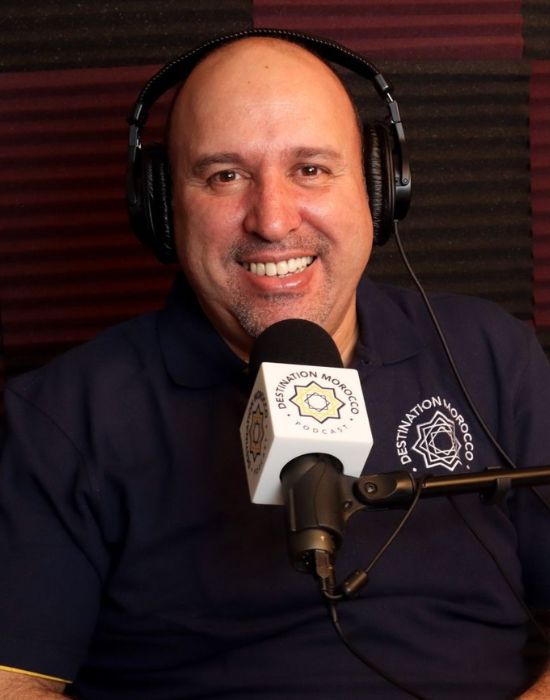
Azedan is a Moroccan travel expert, entrepreneur, and the host of the Destination Morocco podcast. Born in Morocco and now based in the U.S., Azedan bridges the gap between international travelers and his home country through immersive, community-centered experiences.
As the founder of Destination Morocco, he focuses on “responsible tourism,” a model that prioritizes local investment, cultural preservation, and direct support for communities like women’s Argan oil cooperatives and traditional artisans. A passionate advocate for his heritage, Azedan’s work is dedicated to showing the world a side of Morocco that goes beyond glossy brochures, focusing instead on the authentic human connections found in the Atlas Mountains, the desert, and the ancient Riyadhs of Fes and Marrakesh.
Know more about him and tourism in Morocco: YouTube | LinkedIn | Instagram | Facebook
