


Tangelic Talks – Season 03 | Episode 16
The Hidden Cost of Green Energy: Confronting Climate Colonialism and Reparations w/ Amber Amoo Gottfried
12 minutes to read
What does climate justice really mean? How do we build an inclusive, intersectional movement that centers communities — not corporations? In this powerful episode of Tangelic Talks, hosts Victoria Cornelio and Andres Tamez sit down with Amber Amoo Gottfried, a climate action facilitator, consultant, educator, and youth learning designer shaping how individuals and institutions engage with climate action.
This conversation goes far beyond typical “climate talk.” It explores environmental anti-racism, decolonial climate action, community-centered planning, burnout, imagination, youth empowerment, and the hidden inequalities built into climate solutions. If you want an insightful look into how climate justice actually works on the ground — this episode unpacks all of it.
Who Is Amber Amoo Gottfried?
Amber works as a climate action facilitator & consultant, supporting:
- Individuals taking meaningful climate action
- Organizations & institutions designing intersectional, anti-colonial climate action plans
- Youth groups learning to connect with nature, build confidence, and develop climate leadership
- Communities experiencing disproportionate climate impacts
- Grassroots networks advocating for system-level climate justice
Her work sits at the intersection of climate action, justice, decolonial practices, community organizing, and social change.
She started in grassroots activism, working with groups such as Global Justice Now, before moving into the wider social impact, education, and consultancy space.
What Exactly Is a Climate Action Plan?
Amber describes a climate action plan as a roadmap for how an organization takes responsibility for its impact and contributes to climate solutions.
Climate action plans typically cover:
- Food systems
- Water security
- Energy
- Equality, diversity & inclusion
- Community outreach
- Youth engagement
- Organizational accountability
But Amber’s approach goes deeper.
She pushes institutions to shift from focusing solely on individual behavior change to systems-level change, centering equity, community voices, and justice.
Grassroots Roots: How Activism Sparked Her Climate Journey
Amber’s entry into the climate space began when she moved to Bristol, known for its cultural activism, community organizing, and artistic expression.
But something felt missing — until she joined Global Justice Now, where climate action and justice were finally connected.
“I realized I wasn’t fully connecting to the environmental movement because the justice element wasn’t being brought in.”
Intersectionality wasn’t optional — it was essential.
Why Intersectionality Matters in Climate Work
Intersectionality is not a buzzword here. Amber explains why environmental problems cannot be solved without addressing race, class, disability, gender, colonialism, and economic inequality.
Example: Pollution
Solutions like low emission zones often displace traffic — and thus pollution — into lower-income, racialized neighborhoods.
Without:
- community consultation
- inclusive planning
- frontline leadership
even “green” solutions can deepen inequality.
This is what Amber calls the margins inward approach:
“If we want to look at issues holistically, we must work from the margins inward.”
The Alienation Many People Feel in the Climate Movement
Amber shares a common issue:
Many young people — especially people of color — feel out of place in climate activism.
There’s pressure to fit a certain “look”:
- the hippie aesthetic
- the punk activist style
- certain cultural norms around activism
This can make people feel like they’re “not the right kind” of activist.
“People don’t want to fight for the planet if they feel they don’t fit the aesthetic.”
This is where intersectional, inclusive climate spaces matter.
Environmental Anti-Racism & Climate Colonialism
Amber’s work with Union of Justice focuses heavily on environmental anti-racism.
This includes:
- addressing Europe’s lack of diversity in environmental institutions
- mapping how climate impacts disproportionately harm communities of color
- investigating how renewable energy supply chains reproduce exploitation
She points out a crucial truth:
🌱 Renewables are not inherently just — not when they rely on mining cobalt, lithium, and other minerals extracted under brutal conditions in places like the Congo.
A truly just transition must go beyond simply swapping fossil fuels for renewables.
It must confront:
- climate colonialism
- global supply chains
- energy consumption patterns in wealthy countries
- economic inequalities
- reparations
Climate Reparations: Complex but Necessary
Amber addresses the growing global conversation around climate reparations:
- Who pays?
- How much?
- How do we calculate historical vs. ongoing harm?
- What mechanisms ensure accountability?
While there’s no simple answer, she notes:
“Acknowledgment is the first step. Without it, we can’t even begin the work.”
The recent ICJ ruling allowing countries to sue for climate damage is a turning point — but the political resistance is significant.
The Role of Imagination in Climate Action
Amber works extensively with young people, helping them reconnect emotionally with the world through nature connection practices.
Many young people today live between two realities:
- anxiety-driven doom narratives
- hope-driven visions of a better world
She helps them build the imagination needed to see climate solutions as possible.
“Imagination helps young people reconnect with themselves and remember what the world could be.”
This shift from despair to agency is essential for climate leadership.
Solidarity vs. Allyship: What’s the Difference?
A powerful point Amber makes:
Solidarity means being part of the struggle — not just cheering from the sidelines.
Climate groups often fall into:
- symbolic allyship
- aesthetic activism
- surface-level statements
Real solidarity means:
- redistributing power
- supporting frontline groups
- amplifying lived experiences
- forming long-term partnerships
- confronting uncomfortable truths
Barriers Community Groups Face: Funding & Capacity
One of the biggest barriers to climate justice work?
Short-term funding. Most London grants are one year, forcing grassroots groups to:
- build programs
- implement them
- evaluate them
- report impact
…only to lose funding and start again.
This lack of stability prevents movements from scaling.
Nature Connection as Climate Motivation
Not all climate action needs to come from fear.
Amber incorporates nature connection practices to cultivate:
- grounding
- belonging
- emotional resilience
- community bonding
- intrinsic motivation
This helps people reconnect with the world — and feel inspired to protect it.
Final Thoughts: Why This Episode Matters
Amber Amoo Gottfried offers one of the most grounded, honest, and intersectional perspectives on climate justice today.
This episode is invaluable for anyone interested in:
- climate justice
- environmental anti-racism
- youth empowerment
- community organizing
- decolonial climate action
- nature connection
- systems change
- solidarity & movement building
It reminds us that climate action is not just about carbon — it’s about people.
It’s about justice.
It’s about imagination.
And it’s about building a future where everyone thrives.

Thought Provoking Q&A Session with Amber Amoo-Gottfried
The idea of a just transition originally focused on ensuring that people working in polluting industries aren’t left behind as we shift to cleaner energy — that they still have work, can support their families, and that the broader economy continues to function.
That's the standard understanding.
In my work, I tend to reframe the concept through the lens of climate colonialism. When we talk about renewable energy and renewable technologies — especially in places like the UK and Western Europe — the conversation often centers on solar panels, wind turbines, and the promise of clean, green solutions. There’s almost a glamorization of these technologies.
But what’s often missing is any discussion of where the minerals required for these technologies actually come from — minerals like lithium and cobalt. For example, in the Democratic Republic of the Congo, communities are facing severe exploitation as global demand for these minerals skyrockets.
So for me, a just transition isn’t simply about shifting workers from fossil fuels to clean energy. It’s about transforming the entire system. It means rejecting the consumerist approach that says, “You can keep consuming at the same rate — we’ll just swap in greener products.” Instead, countries in the Global North need to reduce their consumption and make reparations to countries harmed by decades of extraction and exploitation.
Justice must extend beyond workers in polluting industries to the people — often in the Global South — who make clean energy possible but are rarely included in the benefits or the narrative.
Yeah, it's a big question — a really complex one. And I think part of what makes it so complex is that we still need basic acknowledgement before anything else. We need recognition of the need for climate reparations in order for the right research to even begin — research that can help us understand what reparations would actually look like in practice.
We also need the infrastructure to figure out what mechanisms would require corporations to contribute, especially within this very tangled global system of importing and exporting. For example, many countries produce the minerals that make renewable technologies possible, or they export oil, yet the pollution or the consequences often originate elsewhere. It’s all part of a deeply interconnected and entangled web.
I'm humble enough to say I don’t have the full answer for how we untangle that web. But I do think a crucial first step is simply acknowledging it — because that’s the only way we can begin to mobilize toward real solutions.
It's a very hard one. But something I will say is that one small victory, at least in comparison to something like the transatlantic trafficking of enslaved Africans — where slave owners received reparations for losing their so-called property — is that today we aren’t seeing conversations about paying reparations to oil companies for the ‘losses’ they might face from transitioning to renewables. That alone is a win. If this were another era, that might have been the conversation. So that’s a little brownie point.
It is a tangled web, but we are slowly unpicking it. And sometimes all it takes is a tipping point — like the ICJ decision — to make policy conversations move faster.
You asked about community, and I think there’s something we’ve seen with, for example, the Palestine protests or Pride: communities coming together for a shared cause, standing with others in solidarity even when the issue doesn’t directly affect them.
Have I seen examples of that in the climate space?
Massively. For example, at Friends of the Earth there’s a project called Planet Over Profit, which partners with communities in Indonesia facing the impacts of palm oil extraction. Communities in the UK have shown real solidarity with people on the ground.
I'd say that within the climate justice space there is a lot of solidarity. The difficulty sometimes is that solidarity can be framed as mere ‘allyship,’ rather than people — especially those of us in places like the UK, the belly of the beast — using our privilege to be part of the action rather than cheering from the sidelines.
When it comes to climate action planning, I actually see solidarity show up more through organisations or individuals rather than through coordinated organising groups. So, for example, my involvement with Friends of the Earth is connected to grassroots organising, but most of what I see relates to organisational climate action planning, not broad cross-movement organising.
Sometimes international partnerships do feature. For instance, one art organisation I worked with in Gloucester included artists — including one from Palestine — to explore the Palestinian experience. That work became part of their outreach and movement-building and helped link climate and social issues. But that kind of international collaboration doesn’t always appear in formal climate action plans. A lot of it depends on the organisation’s capacity and context.
When we talk about meaningful allyship, I actually see it as a bit of an oxymoron, especially when you compare allyship to solidarity. Solidarity means being part of the movement, not cheering from the sidelines — especially when you’re operating from the ‘belly of the beast,’ like in the UK.
So for me, meaningful allyship is solidarity. It means being actively involved in campaigns. A clear example of the difference is pinkwashing: meaningful solidarity might be organising equality initiatives for LGBTQ+ youth or creating spaces for communities to tell their stories. ‘Allyship,’ on the other hand, might look like a company changing its logo to a rainbow for one month of the year. There’s a big difference between those two.
Yeah, I think imagination is so important for the climate crisis, but also for wider social issues. And I think it's especially important for young people. We’re living in a technological age where young people use social media so much, but the algorithms are designed so they only see two things:
an echo chamber of what they already believe, and
content that triggers strong responses – often grief or anger.
So young people can get stuck in a loop of seeing posts that make them feel hopeless or in despair. And because of that, they’re starting to lose this natural skill of imagination that used to come so easily.
When working with youth, I almost think of imagination as a way of reconnecting individuals to themselves – reconnecting them to the natural instincts they have about how the world could be. And it’s really interesting to watch young people process that.
I remember once facilitating a session for Bristol Old Vic, and one of the young people said they felt like they were “glitching” between two possible worlds:
– one where communities come together and create beautiful, community-led change,
– and another shaped by what they see in the media, full of grief and despair.
So sometimes the work is helping young people navigate that glitching – helping them process it and find some sense of agency in deciding which world they want to move toward.
Mm-hmm. Yeah. So a lot of my nature connection work is motivated by the desire to plant that initial seed – the seed of reconnecting with the world. When everyone is so disconnected, it can be hard to even imagine connection.
I remember when I was younger, social media created a sense of disconnection because young people felt lonely seeing what their friends were doing. But now we’re in a completely different realm: people are living in very different worlds, with different conceptions of what’s happening around them. It’s a new kind of isolation we haven’t seen before.
Much of the nature connection work is about feeling more connected to oneself and to the world around you. Within a community space, we encourage interactions that are vulnerable and heart-to-heart, allowing people to connect beyond surface-level interactions.
This work aims to plant that initial seed that helps young people – and communities of all ages – reconnect with themselves. In doing so, they find a sense of meaning and motivation to care for and regenerate the world. Through this process, they become grounded – to each other, to themselves, and to nature. It’s a win on all fronts.
Amber Amoo-Gottfried
Climate Action Facilitator & Consultant
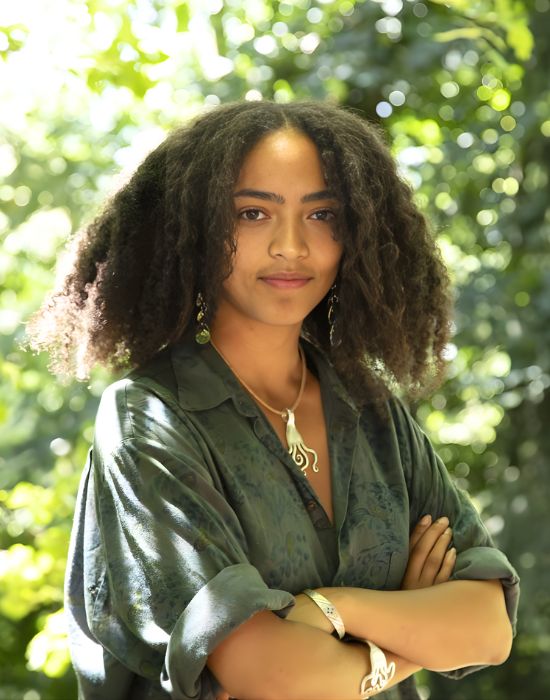
Amber is a climate justice advocate and youth learning designer for social change, championing intersectional and interdisciplinary approaches to climate action. They are a beVisioneers Fellow with global ‘learning by doing’ organisation, The DO, a Campaigns Associate for pan-European environmental anti-racism organisation, Union of Justice, and a Board Trustee for British nature-connection collective, The Visionaries.
Working with educators, arts institutions, local authorities, non-profits, and funders —such as the Natural History Museum, Greater London Authority, and Green European Foundation— they are keen to facilitate cross-sector and community-led approaches to climate education and action planning. Their work invites us to envision a world where ‘sustainability’ no longer reinforces global systems of marginalisation and exploitation, but reimagines and rebuilds towards a new future which is just, regenerative, and truly sustainable, for all.
